For most email accounts, use SMTP on port 587 (with STARTTLS) to send mail and IMAP on port 993 (over SSL/TLS) to receive it. If you download mail with POP3 instead, use port 995. Always choose an encrypted port, and set your username to your full email address.
Key takeaways
- SMTP sends email, while IMAP and POP3 receive it, so you always need one sending port and one receiving port.
- Sending (SMTP): use port 587 with STARTTLS (the modern default) or port 465 over SSL/TLS. Avoid port 25 in an email app.
- Receiving (IMAP): use port 993 over SSL/TLS. Receiving (POP3): use port 995 over SSL/TLS.
- Choose IMAP if you read mail on more than one device, because it keeps every device in sync with the server.
- Set your username to your full email address and turn on "outgoing server requires authentication", or sending will fail.
The three protocols: SMTP, IMAP and POP3
Setting up email in an app like Outlook, Apple Mail, or Thunderbird means filling in server names, ports, and a couple of tick-boxes. It looks technical, but it comes down to three protocols — the agreed languages email software uses to move messages around. Each has one job. Once you know which does what, the settings screen stops being a guessing game. This guide sits under our wider explainer on what email hosting is, which covers where your mailbox actually lives.
SMTP — sends your email
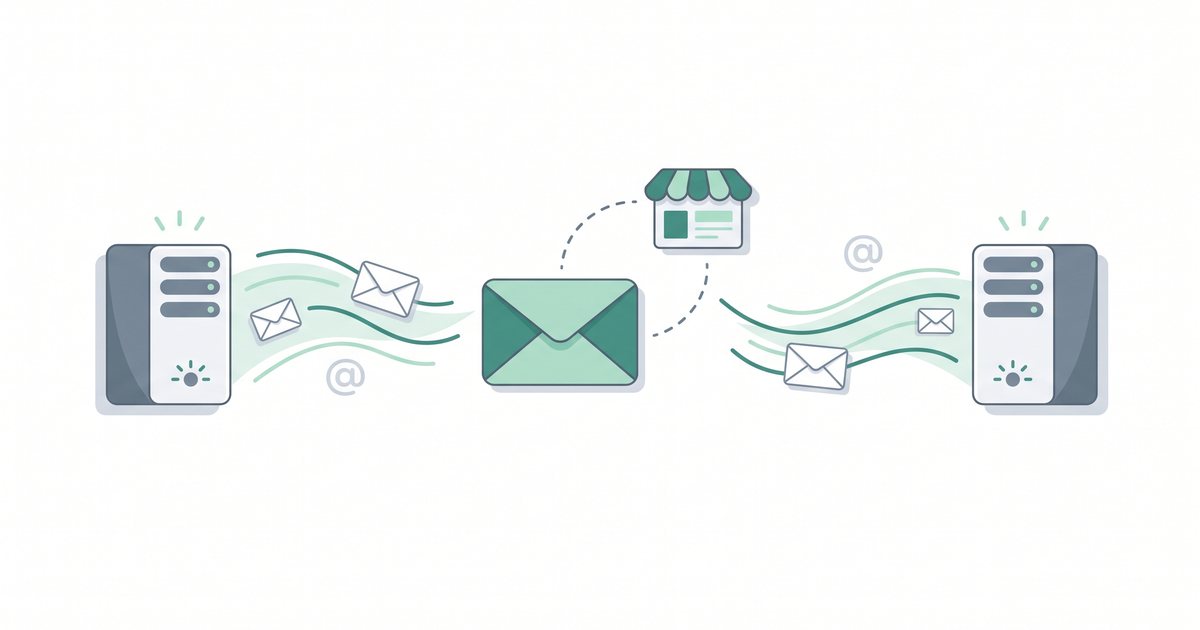
SMTP (Simple Mail Transfer Protocol) is the protocol that sends mail. When you hit "Send", your email app hands the message to your provider's SMTP server, which then relays it toward the recipient's mail server. SMTP is the outgoing half of your setup. If your outgoing settings are wrong, mail lands in your Outbox and never leaves — a problem we cover in depth for WordPress in why WordPress is not sending email.
IMAP — receives and syncs your email
IMAP (Internet Message Access Protocol) is one of two ways to receive mail. Its defining feature is that it keeps your messages on the server and mirrors them to every device you use. Read an email on your phone and it shows as read on your laptop; move a message to a folder and that folder looks the same everywhere. IMAP is the incoming half of your setup for anyone who checks mail in more than one place.
POP3 — downloads your email to one device
POP3 (Post Office Protocol, version 3) is the other way to receive mail. Instead of syncing, POP3 downloads messages to a single device and, by default, often removes them from the server afterwards. That was useful when storage was scarce and people used one computer. Today it mostly causes confusion, because mail read on one device does not appear on the others. POP3 still has a niche, which we cover next.
IMAP vs POP3: which should you use?
For nearly everyone, the answer is IMAP. If you read email on a phone and a laptop — or even just a phone and webmail — IMAP keeps them all showing the same inbox, the same folders, and the same read/unread status. Because your mail stays on the server, it is also safe if a device is lost or wiped, and it is easy to move to a new phone or computer without losing history.
Use POP3 only in a narrow case: you read mail on a single device, you want messages stored locally on that machine, and you deliberately want to free up space on the server by removing mail after download. Some people also use POP3 to keep a personal offline archive. If that is not you, choose IMAP.
A quick tip: do not set up the same account with IMAP on one device and POP3 on another. If POP3 deletes messages from the server after downloading, your IMAP device can lose mail it never got to see. Pick one method and use it everywhere.
The standard email ports
A port is a numbered "door" on the mail server for a particular kind of traffic. Each protocol has a standard encrypted port and, usually, an older one. The table below lists the ports you will actually type into an email app. The recommended choice for each protocol is in bold.
Standard SMTP, IMAP and POP3 ports (as of 2026).
| Protocol |
Port |
Encryption |
What it is for |
| SMTP (send) |
587 |
STARTTLS |
The modern default for email apps. Message submission from your client to your provider. |
| 465 |
SSL/TLS |
SMTP over SSL/TLS. A fine alternative if your provider prefers it. |
| 25 |
Plain / STARTTLS |
Server-to-server relay. Usually blocked for regular email apps — do not use it to send. |
| IMAP (receive) |
993 |
SSL/TLS |
Recommended. IMAP over an encrypted connection. |
| 143 |
STARTTLS |
IMAP that upgrades to encryption. Use only if 993 is unavailable. |
| POP3 (receive) |
995 |
SSL/TLS |
Recommended. POP3 over an encrypted connection. |
| 110 |
STARTTLS |
POP3 that upgrades to encryption. Use only if 995 is unavailable. |
In short: to send, use 587 (or 465). To receive with IMAP, use 993. To receive with POP3, use 995. If your host lists slightly different numbers, follow their documentation — but these are the settings the vast majority of providers use.
Encryption: SSL/TLS vs STARTTLS
Every port above is either "SSL/TLS" or "STARTTLS". Both protect your email as it travels, so your password and messages cannot be read in transit. They just start the encryption at different moments.
SSL/TLS (sometimes labelled "implicit TLS" or just "SSL") means the connection is encrypted from the very first moment. The client and server agree on a secure link before any email data is exchanged. Ports 465 (SMTP), 993 (IMAP), and 995 (POP3) work this way.
STARTTLS means the connection starts as a plain (unencrypted) conversation and then upgrades to encryption using a "STARTTLS" command before your password is sent. Ports 587 (SMTP), 143 (IMAP), and 110 (POP3) use this method. When it works correctly, STARTTLS is just as secure as SSL/TLS — the whole exchange still ends up encrypted.
The rule to remember: always pick an encrypted port. For sending, 587 (STARTTLS) is the modern default and 465 (SSL/TLS) is an equally safe alternative — choose whichever your provider recommends. For receiving, prefer the SSL/TLS ports 993 and 995. Never use a "None" or "no encryption" setting on a real mailbox.
How to find your settings and set up an email client
Here is the full process, from finding your server names to sending a test message. The exact wording of each screen varies a little between apps, but the fields are always the same.
- Find your incoming (IMAP or POP3) and outgoing (SMTP) server names in your host's control panel or webmail. They are usually listed under an "email accounts", "mail configuration", or "connect a device" section, and often look like
mail.yourdomain.com.
- In your email app, open account settings and choose add an account (a manual or "advanced" setup gives you the port fields you need).
- Enter the incoming server and its port. For IMAP, use
993 with SSL/TLS. (If you chose POP3, use 995 with SSL/TLS instead.)
- Enter the outgoing SMTP server and its port. Use
587 with STARTTLS, or 465 with SSL/TLS if your provider prefers that.
- Set the username to your full email address (for example
you@yourdomain.com, not just you) and enter your mailbox password.
- Make sure "outgoing server (SMTP) requires authentication" is turned ON, usually set to "use the same username and password as incoming".
- Test sending and receiving: send an email to yourself and confirm it both leaves your Outbox and arrives in your inbox. If both work, your setup is complete.
If you are wiring up email for a domain of your own, our guide to setting up custom domain email walks through creating the mailbox itself before you reach this configuration step.
Common mistakes to avoid
Watch out: the four errors below cause the large majority of "it won't connect" and "it won't send" support tickets. Check them first before assuming the server is down.
Using port 25 to send from an email app. Port 25 is meant for server-to-server relay, and most internet providers and hosts block it from ordinary connections to fight spam. If your outgoing mail hangs or times out, and you have port 25 set, switch to 587 or 465.
Choosing the wrong encryption for the port. Each port expects a specific method: 587 pairs with STARTTLS, while 465, 993, and 995 pair with SSL/TLS. Mixing them — for example SSL/TLS on port 587 — usually produces a connection or certificate error. Match the encryption to the port from the table above.
Turning off SMTP authentication. If "outgoing server requires authentication" is switched off, the server cannot confirm you are a real account holder, so it refuses to send. Keep this setting ON and point it at your normal email login.
Using the mailbox name instead of the full email address as the username. Almost every provider expects the whole address — you@yourdomain.com — as the username for both incoming and outgoing. Entering just you is a very common reason a login is rejected.
Frequently asked questions
What ports should I use for email?
For most accounts, use SMTP on port 587 (STARTTLS) to send, and IMAP on port 993 (SSL/TLS) to receive. If you download mail with POP3 instead of IMAP, use port 995 (SSL/TLS). Port 465 is a valid alternative for sending. Always pick an encrypted port and set your username to your full email address.
What is the difference between IMAP and POP3?
Both receive email, but IMAP keeps your messages on the server and syncs them across every device, so your inbox looks the same on your phone, laptop, and webmail. POP3 downloads messages to one device and often deletes them from the server afterwards. Choose IMAP if you use more than one device, and POP3 only if you want a single-device download.
Should I use port 587 or 465 for SMTP?
Either works and both are secure. Port 587 with STARTTLS is the modern default for email apps and is the safest first choice. Port 465 uses SSL/TLS from the start and is a fine alternative if your provider recommends it. If one is blocked or gives errors, try the other. Avoid port 25 for sending from a client.
What is STARTTLS?
STARTTLS is a method that begins a connection in plain text and then upgrades it to an encrypted one before any password or message is sent. It is used on ports 587, 143, and 110. When it works correctly it is just as secure as an SSL/TLS connection, because the whole exchange still ends up encrypted.
What is the difference between SSL/TLS and STARTTLS?
SSL/TLS encrypts the connection from the very first moment, before any email data is exchanged, and is used on ports 465, 993, and 995. STARTTLS starts as a plain connection and then upgrades to encryption on ports 587, 143, and 110. Both protect your mail in transit. The key point is to always choose one of them and never send email with no encryption.
Why can't I send email from my client?
Sending failures almost always come from the outgoing (SMTP) settings. Check four things: you are using port 587 or 465 rather than blocked port 25, the encryption matches the port, "outgoing server requires authentication" is turned on, and your username is your full email address. Correcting one of these fixes most stuck-in-Outbox problems.
Do I use the same server address for incoming and outgoing?
Often yes. Many hosts use one hostname, such as mail.yourdomain.com, for both incoming (IMAP or POP3) and outgoing (SMTP), with different port numbers telling them apart. Some providers list separate names like imap.yourdomain.com and smtp.yourdomain.com. Always follow the exact server names shown in your host's control panel or webmail setup page.
Summary
Email settings come down to two halves. SMTP sends — use port 587 with STARTTLS, or 465 with SSL/TLS, and never port 25 from an app. IMAP or POP3 receives — use IMAP on port 993 if you read mail on more than one device (which is most people), or POP3 on port 995 if you want a single-device download. Always pick an encrypted port, set your username to your full email address, and keep SMTP authentication on. Get those right and both sending and receiving will work on the first try. Next, if the mailbox itself is not set up yet, see our guide to custom domain email to create your address before you configure these ports.
References
- IANA — Service Name and Transport Protocol Port Number Registry (registered ports for SMTP, IMAP, POP3, submission, and their secure variants).
- IETF — RFC 6409 (Message Submission, port 587), RFC 8314 (recommending implicit TLS on ports 465, 993, and 995), and RFC 3207 (SMTP over STARTTLS).
- IETF — RFC 3501 (IMAP) and RFC 1939 (POP3) protocol definitions.